



Clean Cooking Association of Kenya (CCAK) recently partnered with the Ministry of Energy and Petroleum (MoEP) and other stakeholders to host the 4th Clean Cooking Week (CCW) in Nakuru from October 24th to 26th, 2023. This event, themed “Towards Universal Access to Clean Cooking Solutions: Invest, Innovate, Involve & Transform,” brought together key stakeholders in the energy sector working in one way or another to accelerate the achievement of universal access to clean cooking by 2028. By Syprose Ochieng, Dr Jon Leary, and Beryl Onjala
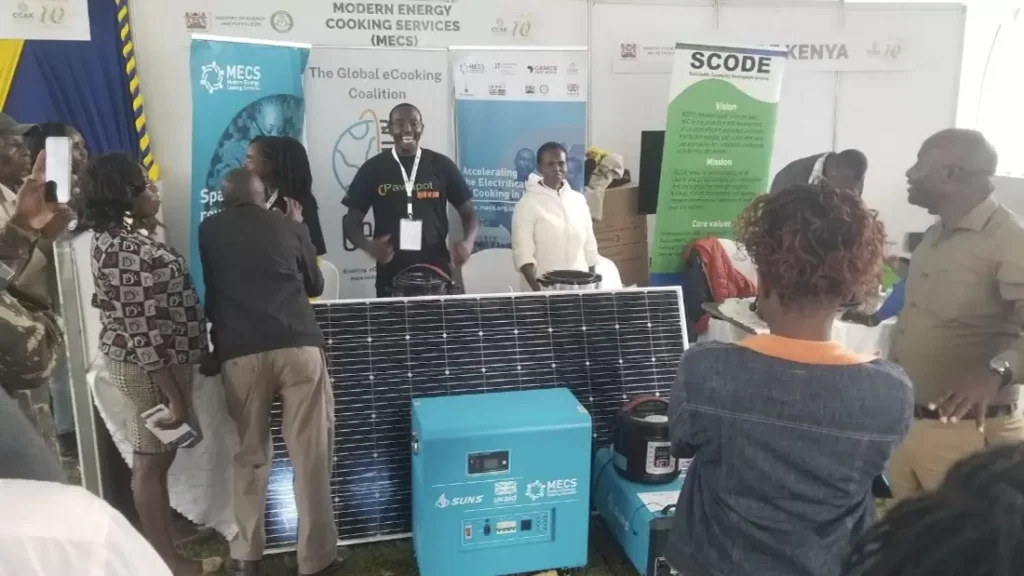
Among the various aspects of Clean Cooking Week is the exhibition of technologies, innovations, and studies within the clean cooking sector. In this blog post, we will explore how electric cooking (eCooking) became the focal point at the exhibition booths during Clean Cooking Week, highlighting its transformative potential and the collective efforts to bring the electricity access and clean cooking sectors closer together.
This year’s Clean Cooking Week marked a significant turning point in the clean cooking landscape. As delegates strolled through the exhibition booths, it was apparent to them that electricity is now fully integrated into the range of clean cooking solutions in Kenya. Beginning at the entrance and extending to the far end of the exhibition center, both research and policy advocates, as well as entrepreneurs, featured electric cooking appliances at their respective stands. This wasn’t always the case – 5 years ago, not a single booth would have featured an electric solution. Back in those days, ICS dominated, with the occasional bioethanol, biogas, or LPG solution on show.
The CCW’s exhibition booths were buzzing with activity, and the presence of eCooking was hard to miss. Here are some key observations:
The prominence of eCooking at Clean Cooking Week was not a coincidence. This was the result of many years of dedicated collaboration and advocacy from MECS and its ever-increasing network of partners who are increasingly seeing electricity as the future of cooking in Kenya.
In conclusion, Clean Cooking Week 2023 was an indication of the power of advocacy, capacity building, and partnership in changing the face of a sector. 5 years ago, eCooking was nowhere to be seen at clean cooking sector convenings and now it is fully integrated into the work of so many different organizations.